
The Octagonlock Scaffolding System is a modular disclock scaffolding solution that combines octagonal ring technology with high-strength steel components to deliver reliable temporary access and support structures for construction projects worldwide.
When project managers evaluate scaffolding options, the decision often comes down to three factors: safety performance, assembly efficiency, and total cost of ownership. The Octagonlock Scaffolding System addresses all three simultaneously, which explains why it has gained traction across Vietnam, Europe, and emerging markets spanning nearly 50 countries.
At its core, the Scaffolding Octagonlock System belongs to the disclock family — the same category that includes ringlock and certain European all-round systems. The distinguishing feature is the shape of the disc welded onto each standard. Where traditional ringlock uses circular rosettes, the octagonlock design employs an eight-sided polygon. That geometric difference cascades into several practical advantages on the jobsite.
The complete system comprises five primary components: octagonal scaffolding standards, octagonal ledgers, octagonal scaffolding diagonal braces, base jacks, and U-head jacks. Huayou manufactures every component in-house, which means tighter quality control from raw material to finished product. The standards are fabricated from Q355 high-strength steel pipe with an outer diameter of 48.3 mm and wall thickness options of 2.5 mm or 3.25 mm. Octagonal rings welded at 500 mm intervals come in 8 mm or 10 mm thickness, providing the structural backbone that supports heavy loads across multiple lift heights ranging from 0.5 m to 3.0 m.
The construction industry demands scaffolding that can adapt to irregular building geometries while maintaining structural integrity under dynamic loads. Industrial maintenance projects — think petrochemical refineries, power plants, and bridge inspection work — require systems that can be erected quickly, reconfigured frequently, and dismantled without component wear. The modular nature of the Octagonlock Scaffolding System makes it suitable for both permanent construction phases and temporary industrial maintenance scenarios.
Independent of marketing claims, the engineering differences between octagonlock and ringlock systems are measurable. Consider the node connection: in an octagonlock configuration, the ledger’s U-groove engages the flat face of the octagonal ring while the wedge pin secures the joint. The result is a dual-contact bearing surface that resists rotational forces more effectively than the point-contact interface found in ringlock assemblies, where the round rosette allows marginal lateral shift during installation.
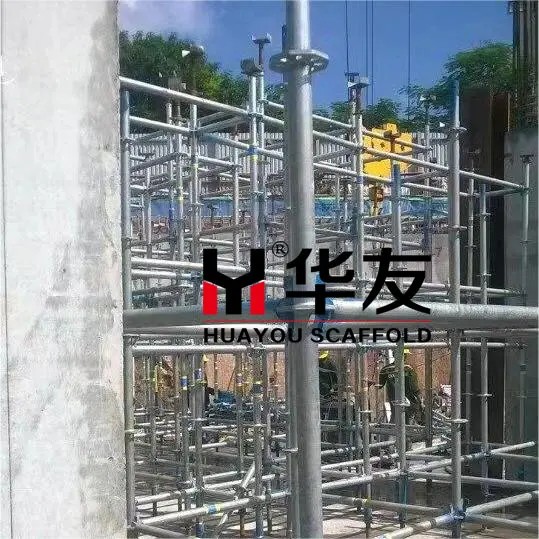

Across Southeast Asia, contractors have deployed the Octagonlock Scaffolding System for multi-story residential complexes where rapid floor-to-floor cycling is essential. In European markets, the same system serves bridge maintenance and industrial plant shutdowns where safety certification and repeatable assembly procedures are non-negotiable.
Since then, the company has built relationships with clients across nearly 50 countries, supported by a vertically integrated operation that controls procurement, production, quality inspection, and logistics under one roof. The factory’s proximity to Tianjin Port reduces inland transportation costs and transit times — a logistical advantage that translates into competitive landed prices for international buyers.
The Octagonlock Scaffolding System represents a deliberate engineering evolution within the disclock scaffolding family. Its octagonal ring geometry, sleeve-spigot standards, curved wedge pins, and comprehensive component range deliver measurable advantages in torsional stiffness, assembly speed, and long-term durability.
Post time: Sep-14-2026


