
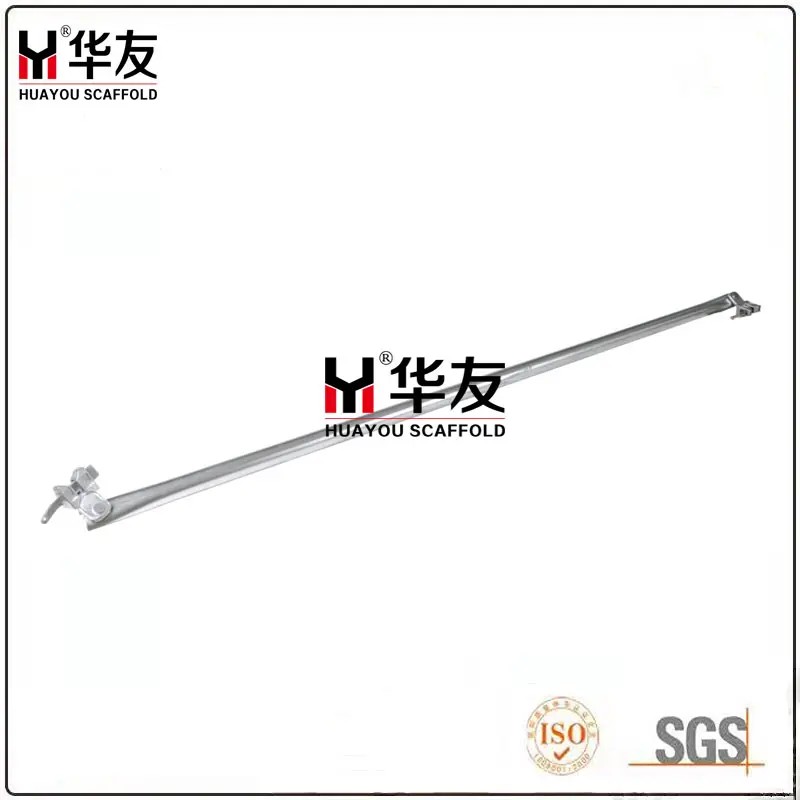
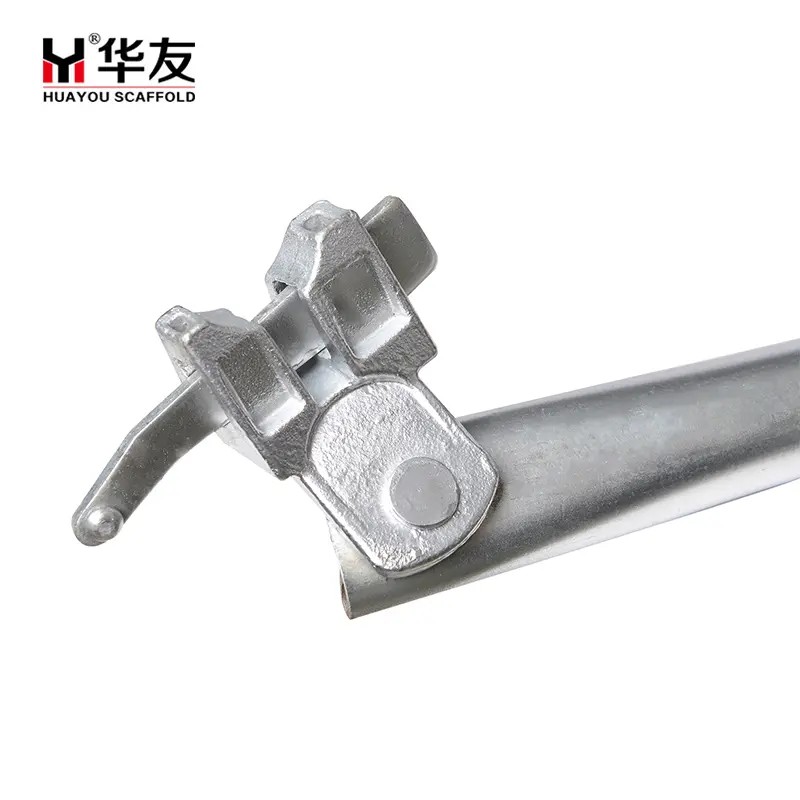
The Ringlock Scaffolding Diagonal Brace is the diagonal member that pins two rosettes on different levels of two standards into a triangle, and that triangle is what keeps a ringlock tower rigid when wind, eccentric loads and nine-to-five site handling all try to rack it apart. Huayou, the Tianjin manufacturer founded in 2013, builds the diagonal brace from Q195, Q235 or Q355 tube in 48.3 mm, 42.2 mm or 33.5 mm outside diameters, riveting a brace head to each end so it grips the disc rosette of the standard instead of depending on a single clamp point. One diagonal cut to the exact bay geometry turns every opening into a stable triangle, which is why the part shows up in nearly every Ringlock Scaffoding layout that has to stay square for weeks on end. A Ringlock System Scaffold bought as a complete package carries that diagonal in every bay, so the geometry arrives with the steel.
On the drawing board the diagonal brace looks like the simplest member in the catalog, and that is deliberate. A tube riveted to a diagonal brace head at both ends seats into two rosettes of different horizontal lines of two ringlock standards; once each diagonal brace head is locked into its slot, the assembly generates diagonal tensile stress across the bay. That stress is what makes the Ringlock System more stable and firm: racking loads are converted into tension running along the steel instead of bending at a bolted lap, which is the failure mode you watch for on older tube-and-coupler rigs. The riveted head of the diagonal brace seats in the rosette whichever way the bay faces, so the same part works on the left side and the right side of the frame without handed drawings. Fewer part numbers on the trailer also means the Ringlock Scaffolding Diagonal Brace is never mixed up with a ledger during erection. Ringlock Scaffolding assembled entirely from one vendor’s parts leaves less room for interface surprises on the first build. In a Ringlock Scaffolding System the diagonal is not an afterthought added because a site engineer asked for one; it is engineered into the bay dimensions from the first drawing, and every Scaffold Ringlock tower built from Huayou drawings carries a Ringlock Diagonal Brace in the same place.
Length is the detail where supplier experience shows. Huayou calculates each Ringlock Scaffolding Diagonal Brace from the designed ledger span and standard span, the way you would solve a trigonometric function of the bay: with a horizontal run from 0.9 m up to 2.4 m and a riser height of 1.5 m or 2.0 m, the diagonal brace leg is fixed before any steel is cut. Orders come in L0.9 m, 1.2 m, 1.57 m, 1.8 m, 2.07 m, 2.1 m or 2.4 m, paired with a Ringlock Scaffolding Horizontal at the working level and a Ringlock Scaffolding Ledger closing the top of the bay, and the Ringlock Scaffolding Ledger length is what fixes the bay width on the drawing. Inside a Ringlock System Scaffold, every bay follows the same diagonal rule, and Ringlock System Scaffolding crews pre-pick parts from the yard because the lengths repeat from floor to floor. The whole Ringlock System assembles without field adjustment. Custom lengths are routine. The production route stays the same every time: material cut to size, welded, surface treated, packed. That predictability matters most on a hire fleet, where the Ringlock Horizontal from one job has to marry the standards of the next without filing, welding or swearing on site. Each Ringlock Horizontal repeats at every level, and the fleet stays interchangeable from the first container to the fifth.
The same diagonal brace does its quiet work across a long spread of industries. Huayou’s ringlock products are exported to more than 35 countries spread over Southeast Asia, Europe, the Middle East, South America and Australia, and the application list runs from bridge piers and facade scaffolding to tunnels, stage support systems, lighting towers, shipbuilding scaffolding, oil and gas engineering, and safety climbing tower ladders. On an External Scaffolding Ringlock System climbing a building face, the diagonal row is what lets wind load travel down the structure instead of piling up on the top deck, which is why facade contractors treat the bracing schedule as load-bearing geometry rather than rigging detail. European Ringlock Scaffolding has been the working benchmark in this category for decades, and the riveted-head diagonal brace is one of its defining details, so a Ringlock System Scaffold specified for a bridge pier carries the same bracing logic as one built for a stage roof. New systems come and go, but European Ringlock Scaffolding keeps the lead because the joint logic never changes. Ringlock Scaffolding Horizontal units run through the same catalog as the standards and ledgers, which keeps matching automatic on site. Crews that erect Ringlock System Scaffolding from the ground up report fewer plumb corrections at the end of the day, because the triangle is already in place behind them. Scaffolding Ringlock components from a single supplier take the guesswork out of that equation: when the diagonal brace, the standard and the ledger come from one quality line, the interface is known before the container opens. A Scaffolding Ringlock System ordered this way keeps its budget honest as well, since spare diagonal braces are standard part numbers instead of one-off fabrications.
Quality control at Huayou runs from raw material test to shipment inspection. A dedicated QC department checks every production procedure, workers train every month and hold the welding skills the diagonal brace heads demand, and the factory sits inside a steel raw-materials zone near Tianjin Port, the largest north port in China, so Q195, Q235 and Q355 pipe arrives freshly supplied at a controlled cost. Annual production can reach 50,000 tons across ringlock, steel board, steel prop, screw jack, frame, formwork and kwikstage lines, which is why mixed containers and batch orders ship as one delivery. Before any container is loaded, Huayou assembles a sample bay with all its system components so the fit is proven rather than assumed, a check that only a manufacturer with control of the whole production line can promise. That assembled proof is why the Ringlock Scaffolding System goes to the port the way it was drawn. Renewing a Scaffolding Ringlock System is only a matter of reordering the worn diagonal braces, which is why hire operators treat the part list as an asset. Scaffold Ringlock orders typically start from MOQ 100 pcs, with delivery in 20 to 30 days depending on quantity, and OEM and ODM work for metal products is offered, which is how many clients end up buying Ringlock Scaffolding direct from the factory instead of through a trader. Scaffolding Ringlock repeat orders then lean on the same punch list, so the second container usually moves faster than the first.
In short, the diagonal brace does the invisible work that keeps the visible structure standing. A Ringlock Scaffolding System is only as rigid as its bracing, and the inexpensive steel tube that closes the triangle decides whether a tower stays plumb under load or slowly opens up at the joints as the weeks go by. Ringlock Scaffoding has built its reputation across more than 35 export markets precisely on details like this one. When the drawing calls for a tower that stays square from the first lift to the final strike, buyers who order Ringlock Scaffolding in volume come back for the same part numbers, and they specify the Ringlock Scaffolding Diagonal Brace with a riveted head, galvanized tube and matched geometry — the Ringlock System as a whole depends on it. An External Scaffolding Ringlock System is only as good as its diagonals, so bracing is never the place to save money. Ringlock System Scaffolding crews on site appreciate the same logic: the diagonal brace locks the bay before the deck is loaded.
Post time: Sep-18-2026


